Google Site Search:
 |
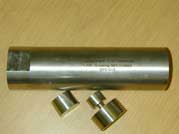
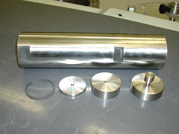
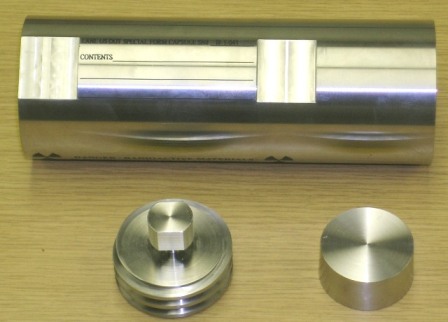
Encapsulation & PackagingField-Sealable Special Form ContainersEarly in OSRP operational history, it was recognized that a method to qualify suspect or leaking sources as special form was needed. During a recovery in 1994, OSRP discovered a container, known as the SFC-7, which had been developed and patented by Radiation Service Organization, Inc. (RSO) in 1989. RSO had developed the SFC-7 to facilitate shipments of radium sources as special form in Type A packaging for disposal. Shipment as Type A allowed 200 times more Ra-226 activity to be packaged and transported in a single container. OSRP staff first used the SFC-7 in the field to encapsulate a Pu-238/Beryllium source, thus making it "special form". As recovery work accelerated in the later 1990s, an increased need arose to field-qualify sources as special form. However, the size limitations of the SFC-7 restricted its usefulness. After discussions with the RSO, Inc., it was agreed that LANL would take on the task of expanding the original RSO design into a suite of SFCs that would be fabricated in various sizes to accommodate the size range and isotopic variation of sealed sources likely to be encountered by OSRP; and which could be easily used at off-site recovery locations. Using the original concept from RSO, OSRP designed and fabricated several prototypes and tested them at LANL against the special form requirements in 49 CFR 173.469. In late 2020, certification for the Model II and Model III SFCs were transferred to Southwest Research Institute (SwRI) to promote commercial availability. Contact SwRI directly for more information on pricing, availability, ordering, and assembly training. [Michael Dammann] The materials intended for encapsulation is limited to solid form in stainless steel capsules, between layers of non-radioactive stainless steel, or affixed to non-radioactive stainless steel by electroplating or other means. And within content limits specified in the certification.
For details on the SFCs, please read our reports.
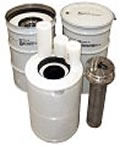
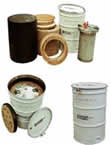
Multifunction ContainersOSRP uses three variations of a multifunction container called a POC (Pipe Overpack Component) to satisfy requirements for U.S. Department of Transportation (DOT) 7A Type A containers. These containers also qualify for use in the TRUPACT II overpack used to transport material to the Waste Isolation Pilot Plant (WIPP) in Carlsbad, N.M. and serve as interim storage containers until disposition occurs. Note: Other packaging configurations may also be used depending on the circumstances.
Each POC incorporates neutron and/or gamma shielding to maintain radiation dose rates as low as possible. In addition, the containers:
|
|||||||||||||||||||